Discover how ROAR AFRICA’s safari journeys support conservation and communities, following two men whose vision is creating lasting change in Rwanda and Zimbabwe.

August 13, 2026
share

What We Choose to Protect

When we imagine a safari, we mostly picture wildlife in beautiful natural settings: elephant herds moving to water in the last light, a leopard draped over the low branch of a marula tree, a gorilla's eyes watching you through the ferns. Almost always, it's the animals.

What is often forgotten, is that most of these stories begin and end with people. A boy who once sought refuge in the jungle; a man who remembered what it is to be proud of one’s school. Along our journey, we have come to know these people, and how their stories have shaped what exists in Africa today, long before any guest arrived.

ROAR AFRICA didn't build these stories. We recognized them and asked how we could become a part of them so that when our guests travel, you aren't just observers, you become part of that story too.

Saving a species, saving a community

Emmanuel Harerimana grew up in Kinigi, a village set beneath the misty volcanoes of Rwanda. When he was a child, he remembers his father hunting inside Volcanoes National Park, so that the meat could be sold to pay Emmanuel's school fees.

Later, during the 1994 Genocide against the Tutsi, his family fled into the forest with nothing. In the weeks that followed, they survived by watching the gorillas to learn which plants were safe to eat. Emmanuel says the gorillas saved his life.

As he grew, so did his reverence for nature and he was eventually drawn to park warden Edwin Sabuhoro, who introduced him to local conservation efforts. His mission became clear: to educate his family and community on why conserving Rwanda's forest and wildlife is crucial for the wellbeing of all.

Six years later, after a training program that took him as far as Japan, Emmanuel was named Rwanda's best guide by the Rwanda Development Board (RDB). In 2011, with support from the Dian Fossey Gorilla Fund, he started a small cooperative, the Muhisimbi Volunteer Guides, training young people from his village as guides to lead visitors through the communities around the park. Some of those guides went on to be chosen by the RDB to become official gorilla guides. Little by the little the value of conserving their environment began to take hold as the young guides saw what was possible when they shared their heritage with others.

The village tours cost nothing, but the visitors who spent time in the communities and the park began asking what more they could do. Thanks to this spontaneous generosity over the years, 6,000 people have access to clean water, school fees have been paid for dozens of children, and homes have been built for vulnerable families.

“We as young people have to play a big role in our communities to convince our fathers and neighbors that they can protect the park instead of destroying it — and show them exactly what kind of benefits they may get if they are conserving that park.” — Emmanuel Harerimana

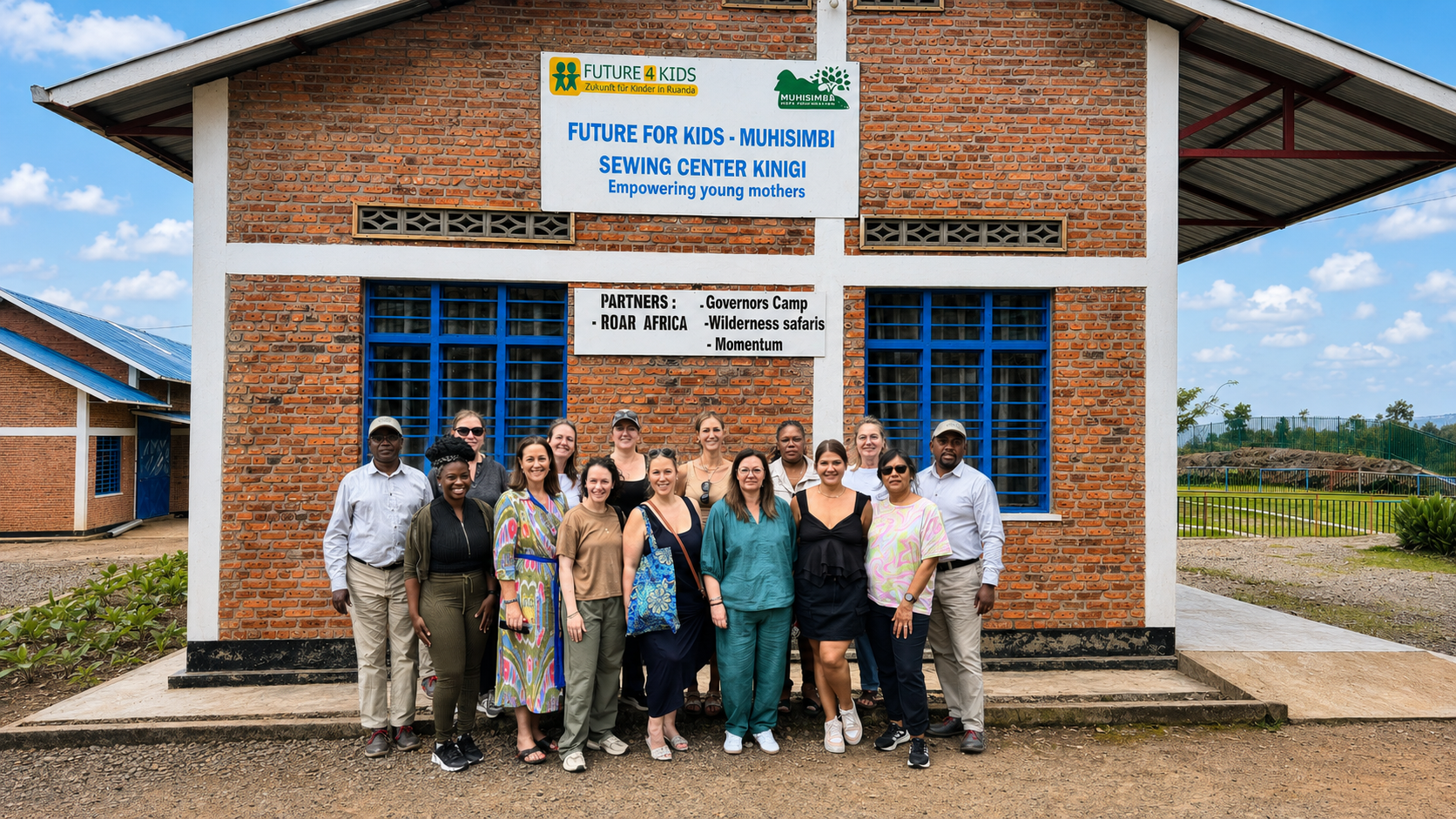
But Emmanual didn’t stop here. In 2020, he launched the Teenager Mother Project welcoming teenage mothers, some as young as fifteen, whose pregnancies had isolated them from their families and communities. For a year, the Kwigira Women and Children Center gives them a home, healthcare and a trade, teaching them sewing skills so that they can start their own businesses. The young women leave with a sewing machine of their own and, more often than not, a way back into the families that once turned them away.

When ROAR AFRICA guests visit Rwanda, they visit the women’s’ center too. Some leave donations, which Emmanuel manages himself, mother by mother. One family, after their visit, drove into the village with their guide and bought diapers, food and baby clothes, before handing them over in person.

Realising a future

On the far side of the continent, in a remote area of Zimbabwe, a similar story is unfolding with a man named Blessing.

Driving through Chisizya, in Binga, thirteen hours from Victoria Falls, Blessing came upon a group of children walking to school and offered them a lift. What he witnessed in that moment changed the future of each child there.

The children were dressed carefully in clean uniforms, smiling and excited for a school day like any other child. But the building they were walking toward was a mere shack. Blessing, who'd had an education most people in Chisizya could only imagine, couldn't reconcile the two things in front of him: the joy on their faces, and the dilapidated room waiting for them. Moved profoundly by what he saw, he went home and started working out how to build the children a school.

Over the next year, using his own savings and the profits of his company, Love For Africa, Blessing began raising money for a brand new school for the community. He called a meeting with every parent and teacher at the school and made an offer: if the parents made the bricks themselves and carried them to the site, he would find the materials, labor, and the rest of what it took to build a school for 140 pupils.

The total budget came to $196,000. Over the past twelve months, more than $79,000 has been raised and spent, most of it from company profits. Approximately $80,000 still needs to be raised to complete the roof, solar installation, furniture, and borehole. Once complete, Blessing promises it will be among the best schools in rural Zimbabwe. This is the power of one man’s vision.

Blessing is clear about how this vision has been achieved: “None of this would have been possible without your support and business,” he wrote to Deborah Calmeyer, ROAR AFRICA's founder, thanking her and the guests who chose to travel through his company.

“When we do well, we always do good.” — Blessing

Emmanuel and Blessing have never met. One man lives in the cloud forest below a chain of volcanoes, the other in the dry heat near the Zambezi. But their stories sit side by side: each saw what was in front of them, decided it wasn't good enough, and built something better with what they could. Both men understood the same thing: when we protect what we value, we protect a future for all.

Every safari gives you something to remember. The best ones give you something to carry home, a reason to keep thinking about a place long after you've left it. Because the most extraordinary places are revealed by the people who have given their lives to them.

“How and where we travel matters. By traveling with ROAR AFRICA, you will become a custodian of the wild, directly helping to solve some of our planet's most critical social, economic, and environmental problems.”

— Deborah Calmeyer, Founder & CEO, ROAR AFRICA

There's a sewing machine in Kinigi with someone's whole future stitched into it. There's a wall in Chisizya made of bricks a child's parents carried there by hand. Neither needed a guest to exist. But they exist a little faster, a little sturdier, because people came and saw, and couldn't walk away without doing something about it.

At ROAR AFRICA, we believe that restorative tourism is inseparable from the African safari. Every journey we curate is rooted in a commitment to the preservation and support of the people, wildlife and environments we visit. These values guide every decision we make, which is why we partner only with properties and individuals who share this long-term commitment to Africa and its future.

To become a part of these stories, please contact us at welcome@roarafrica.com and to learn more about the ripple effects of our work, visit Our Impact.

Subscribe  
TO RECEIVE THE LATEST UPDATES

By subscribing you're confirming that you agree with our Terms and Conditions.

ROAR AFRICA