The living spine of Africa

December 12, 2025
share

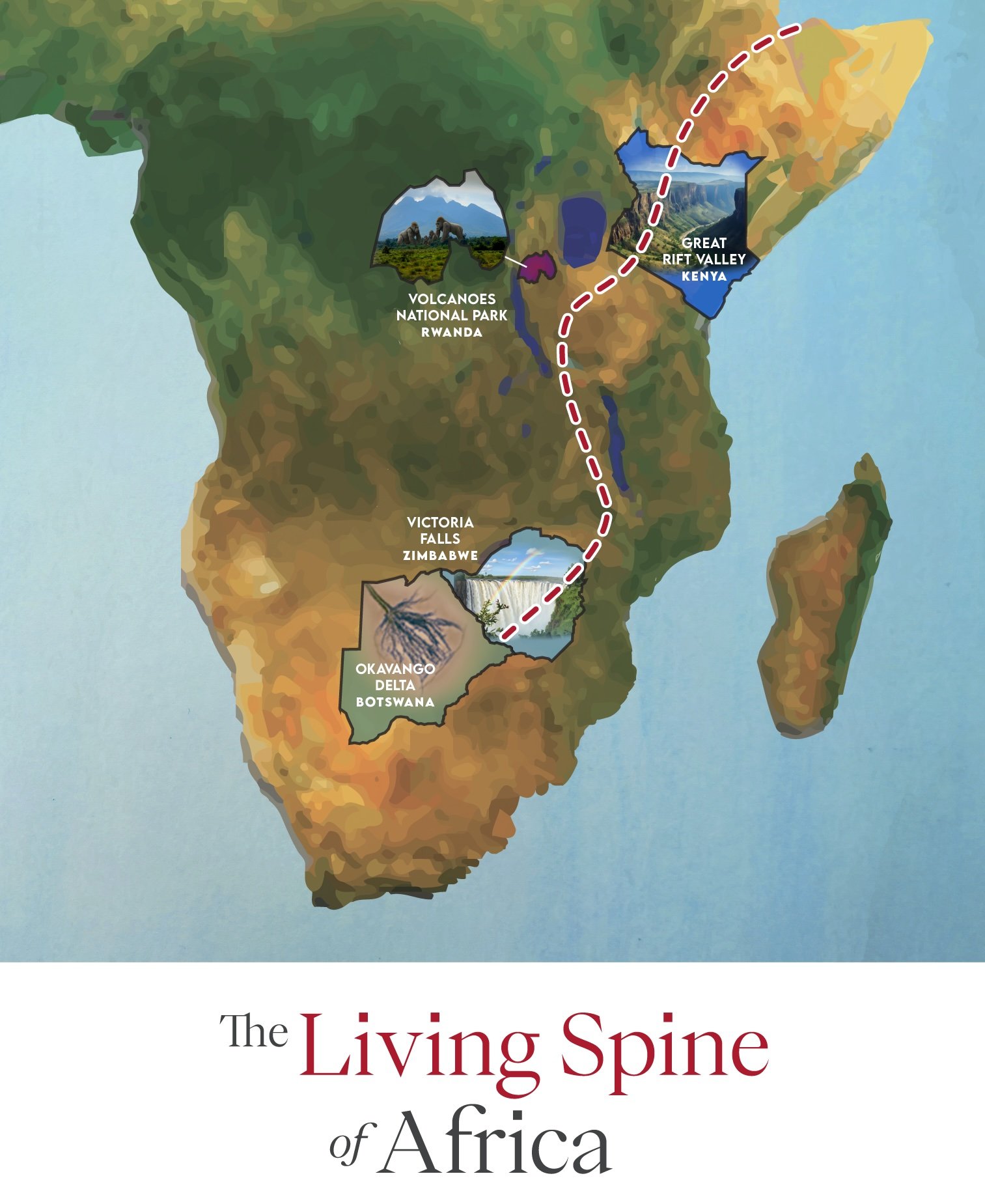
The story of the Great Rift Valley begins deep in time, when the African continent first began to pull itself apart. Invisible yet relentless forces stretched the crust, cracking it open from the Red Sea southward through the heart of the continent. Along that shifting spine lie some of Africa’s most astonishing landscapes, each a different expression of the same restless geology.

Imagine 3,728 miles of valley where Africa is very slowly splitting in two. Along that valley lie roaring waterfalls, endless plains and volcanoes. That is the Great Rift Valley. And it is not a single valley, but a vast tectonic system stretching from the Middle East down through East Africa to southern Africa, formed by the slow pulling apart (rifting) of the Earth’s lithosphere.

When designing The Greatest Safari on Earth℠, we traced this living spine in a journey not just across Africa, but along the path that shaped the continent and humanity itself.

Our journey begins in Zimbabwe, where the Zambezi River meets a plateau of ancient basalt. Through patient erosion, it has carved one of Earth’s most dramatic spectacles: Victoria Falls - Mosi-oa-Tunya, “The Smoke that Thunders.” Here, the river hurls itself into a chasm carved along rift-born fractures, its thundering mist rising from a canyon system millions of years in the making. Standing on the lip of the falls, wrapped in utter awe at the spray and the water, you feel its sheer power to carve gigantic creases in the rock, gorge by gorge. It is transcendent. The Falls are not merely a wonder of water—they are the sound of Africa’s crust remembering where it once tried to tear.

Not far to the south and west lie the limestone caves of the Cradle of Humankind, where fossils of Australopithecus and other early ancestors reveal that the soil of southern Africa once sheltered the beginnings of us all. Long before language or fire, these rocks were already telling the story of movement, of a planet flexing and shifting beneath a future humankind.


From the thunder of the falls, we fly west into the Okavango Delta in Botswana. Worlds apart in look but again carved by water, the land dips into the Okavango Rift Zone, the youngest limb of this tectonic story. Here, the Okavango River spreads its waters not to the sea but into a shimmering inland delta in the shape of a hand (visible from space). Each year, as the rift floor sinks by fractions of a millimetre, the delta cradles floodwaters from the north that sustain grasslands, trees and mammoth anthills that in turn support elephants, lions and hundreds more plains game and wild species.

The floodwaters that pulse through the delta have sustained people for tens of thousands of years—San hunter-gatherers tracing hippo channels and reading the Earth’s heartbeat through reeds and stars. The Okavango is the Great Rift’s soft-spoken twin to Victoria Falls: where one roars, the other whispers, but both exist because the Earth is stretching beneath them.


Traveling north and east, the Rift grows bolder, cutting through high plateaus and down into the rolling grasslands of the Masai Mara. The escarpment is a visible edge of the living spine, a vast corridor guiding the great migrations of wildebeest and zebra in a seasonal journey that echoes the slow movement of the plates and mirrors the planet’s deeper drift. When you watch the herds pour across the Mara, hooves drumming the earth, it feels, quite literally, like an echo of an ancient rhythm and the movement of the Earth itself.

It is in this very place that our own ancestors walked. Fossils in nearby Olduvai Gorge and the Turkana Basin reveal that the first humans rose within this same tectonic scar. The Rift’s alternating wetlands and dry spells honed our adaptability, shaping minds that could plan, cooperate, and imagine.


Farther still, the rift reaches its volcanic crescendo in the Virunga Mountains on the borders of Rwanda, Uganda and the Democratic Republic of Congo. Here magma rises through the wounds of the Earth, forming a chain of dramatic peaks—Nyiragongo, Karisimbi, Mikeno—whose fertile slopes are home to misty rainforests and mountain gorillas. Fire rather than water is the storyteller here, yet it speaks the same tectonic language that carved the falls and molded the delta.

The mountain gorillas, our closest living relatives, mirror in their eyes a lineage that reaches back to those first hominid fossils of the south. The Virungas are a meeting of past and present, a living echo of the kinship between all life shaped by this restless continent. Here, creation and destruction remain inseparable, and the pulse of the Earth beats within every living being it has formed.

Together these four places—Victoria Falls, the Okavango Delta, the Masai Mara, and the Virunga Volcanoes—compose a single continental narrative. Each chapter reveals a different mood of the Great Rift Valley: fracture, subsidence, migration and eruption. The Greatest Safari on Earth is a journey that tells not just the Earth’s story but our own. This is the landscape that carved our rivers, shaped our migrations and tested our resilience. Here, the planet’s deep time meets human time: the slow drift of continents and the spark of consciousness, entwined along one living spine of Africa—where the Earth, and humanity itself, are still in motion.

To secure the last two places on the Greatest Safari on Earth in 2026 (from August 10 – 22) or to book for 2027 (August 25 - September 6), please email us on welcome@roarafrica.com or, for more information, please click here.

Subscribe  
TO RECEIVE THE LATEST UPDATES

By subscribing you're confirming that you agree with our Terms and Conditions.

ROAR AFRICA